Love
Love is the animating principle of Dante's universe, the force that moves the sun and the other stars and the standard against which every soul is measured. In the Divine Comedy, love is not a single emotion but a comprehensive cosmic power: it is the creative energy of God, the natural inclination of all beings toward their proper good, and the root of both virtue and vice. The poem's entire moral and theological architecture rests on the distinction between rightly ordered and disordered love, and the journey from Hell to Paradise is, at its deepest level, an education in what it means to love well.
The Cosmic and Theological Foundation of Love
The poem opens and closes with love. In the first canto of the Inferno, Dante describes the moment of creation as the time "the Love Divine / At first in motion set those beauteous things" . This identification of God with love is not merely poetic; it is the metaphysical bedrock of the entire cosmos. The Paradiso begins with the same assertion: "The glory of Him who moveth everything / Doth penetrate the universe, and shine / In one part more and in another less" (E09761-E09763). Love is the attribute of God that accounts for creation, motion, and the hierarchical ordering of all existence. Beatrice explains that all things have an innate inclination toward their proper end, an "instinct" that "bears away the fire towards the moon" and is "in mortal hearts the motive power" (E09875-E09877). This natural love is inherent and without error; it is the spiritual love, which involves choice and intention, that can go astray.
Virgil's Discourse on Love in Purgatory
The most systematic treatment of love as the foundation of moral life occurs in Purgatorio, Cantos XVII and XVIII, where Virgil delivers a philosophical lecture on the nature of love. He begins by stating a universal principle: "Neither Creator nor a creature ever, / Son, was destitute of love / Natural or spiritual; and thou knowest it" (E07342-E07344). Natural love is always without error, but spiritual love can err in three ways: by loving an evil object, by loving a good object too much, or by loving it too little (E07346-E07353). From this premise, Virgil derives the entire taxonomy of sin and virtue: "Hence thou mayst comprehend that love must be / The seed within yourselves of every virtue, / And every act that merits punishment" (E07354-E07356). Sin, therefore, is not a violation of arbitrary rules but a corruption of love itself. The three categories of disordered love toward one's neighbor—pride, envy, and wrath—are described as the evil that "one loves" being "of one's neighbour" (E07364-E07374). The sins of the upper terraces of Purgatory—sloth, avarice, gluttony, and lust—are forms of loving a good object with either too little or too much vigor (E07376-E07390). This framework makes the entire process of purgation a re-education of love, a gradual correction of the soul's affections until they are perfectly aligned with God's will.
The Power and Danger of Earthly Love
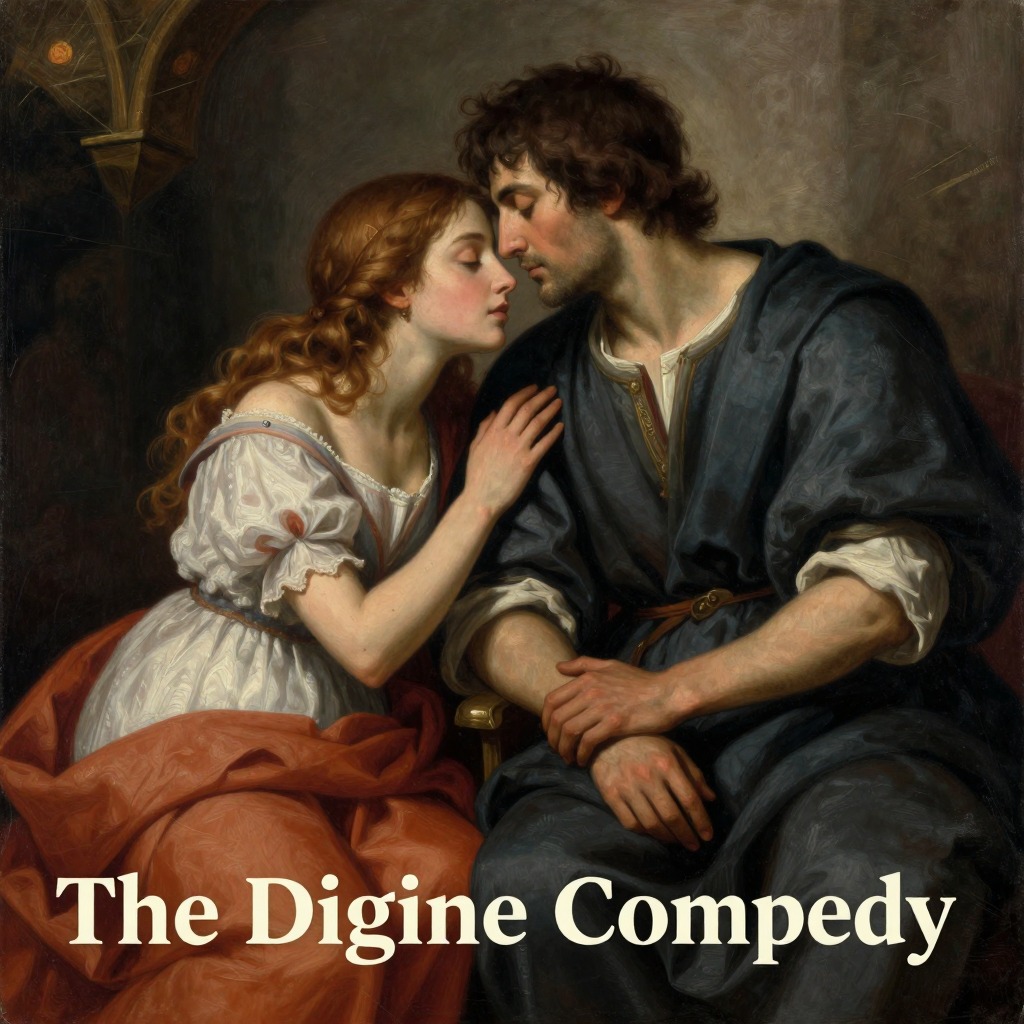
The Inferno provides the most vivid demonstrations of love gone wrong. In the second circle, the lustful are swept forever by an infernal hurricane, and among them are Francesca da Rimini and her lover Paolo. Francesca's account of their fall is a tragedy of misdirected love: "Love, that on gentle heart doth swiftly seize, / Seized this man for the person beautiful / That was ta'en from me, and still the mode offends me. / Love, that exempts no one beloved from loving, / Seized me with pleasure of this man so strongly, / That, as thou seest, it doth not yet desert me; / Love has conducted us unto one death" (E00877-E00884). Her words reveal the irresistible power of erotic love, but also its danger when it is not governed by reason and divine law. The love she describes is genuine, but it is also fatal because it has become an end in itself, detached from the order of charity. Dante is so moved by her story that he swoons, demonstrating that even the pilgrim is vulnerable to the seduction of a love that is beautiful but disordered.
Beatrice and the Transformation of Love
The figure of Beatrice represents the transformation of love from a natural, earthly passion into a divine, redemptive force. When Dante first sees her in the Earthly Paradise, he is overwhelmed by the power of "ancient love": "As soon as on my vision smote the power / Sublime, that had already pierced me through / Ere from my boyhood I had yet come forth, / To the left hand I turned with that reliance / With which the little child runs to his mother, / When he has fear, or when he is afflicted, / To say unto Virgilius: 'Not a drachm / Of blood remains in me, that does not tremble; / I know the traces of the ancient flame'" (E09200-E09208). This love, however, is no longer the romantic attachment of youth; it has been purified and redirected. Beatrice herself explains that her death should have taught Dante to love only what is eternal: "Never to thee presented art or nature / Pleasure so great as the fair limbs wherein / I was enclosed, which scattered are in earth. / And if the highest pleasure thus did fail thee / By reason of my death, what mortal thing / Should then have drawn thee into its desire?" (E09355-E09360). Her rebuke is a lesson in the hierarchy of loves: earthly beauty is a reflection of divine beauty, and to mistake the reflection for the reality is to fall into error.
The Beatific Vision and the Final Unity of Love
The poem culminates in the vision of God, which is described as a vision of love itself. In the Empyrean, Dante sees the Trinity as three circles of light, and his final understanding is that the entire universe is bound together by love: "I saw that in its depth far down is lying / Bound up with love together in one volume, / What through the universe in leaves is scattered" (E14490-E14492). The last line of the poem declares that his desire and will are turned "by the Love which moves the sun and the other stars" . This is the ultimate resolution of the poem's entire argument: love is not merely a human emotion or a moral principle but the very substance of reality, the force that creates, sustains, and perfects all things. The journey from the dark forest to the vision of God is a journey from confused and misdirected love to love that is perfectly ordered, free, and at rest in its source.